

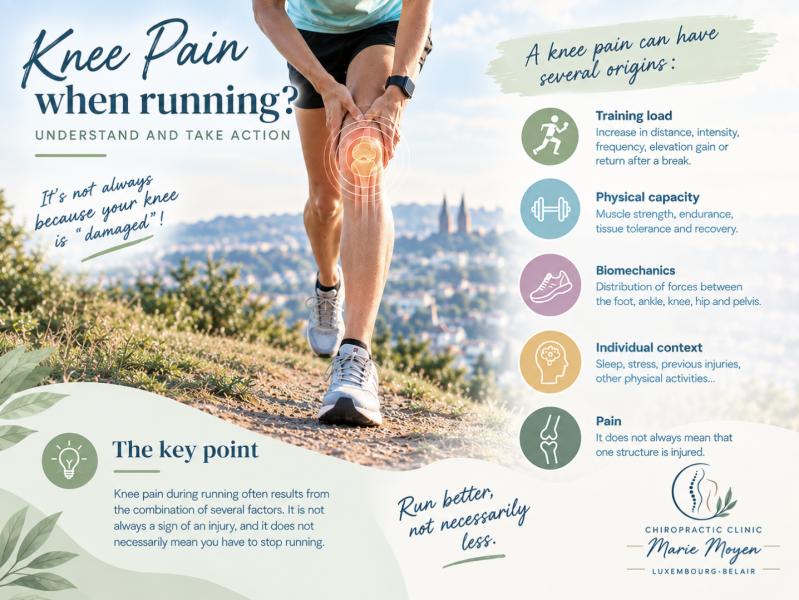
Knee pain is one of the most common problems experienced by runners. It can develop gradually over the course of training, after returning to running, when increasing mileage, or sometimes without any obvious change in training habits.
However, experiencing knee pain while running does not necessarily mean that your knee is “damaged”.
Running-related pain is often multifactorial. It can be influenced by training load, the ability of muscles and tissues to tolerate that load, previous injuries, certain running mechanics, and more broadly, the overall context in which training takes place.
The goal is therefore not simply to identify “what is out of place”, but to understand why the knee has become painful in this particular situation.
Knee pain does not always have a single cause
The knee is a joint that has to absorb and transmit significant forces during running.
With every stride, these forces are distributed throughout the foot, ankle, knee, hip and pelvis. The body has a remarkable ability to adapt, but this ability is not unlimited.
Pain may develop when the demands placed on the body temporarily exceed its current capacity to tolerate them.
This does not necessarily mean that a structure has been damaged. Pain is a complex experience influenced not only by mechanical factors, but also by many individual factors.
This is why looking for one single cause of knee pain can be overly simplistic.
Does training load play a role?
Yes, but it is important to be precise.
Increasing mileage, training frequency, speed, elevation or the duration of runs can change the demands placed on the body.
Returning to running after several weeks away can also represent a significant increase in training load, even when the number of miles or kilometres seems relatively low.
However, it would be too simplistic to say that “running too much inevitably causes an injury”.
The relationship between training load and injury is complex. Current research highlights the importance of considering a runner's previous injury history, training load and individual physical capacity rather than looking for a universal threshold that applies to everyone.
The better question is therefore not simply:
“How much am I running?”
but rather:
“Is my body currently prepared to handle this level of training?”
What if I haven't changed my training?
This can happen too.
Knee pain can appear even when your training programme seems unchanged.
Your ability to tolerate the same workload can vary depending on many factors, including recovery, sleep, stress, other physical activities, previous injuries and your current level of physical preparation.
Two people following exactly the same training programme will not necessarily respond in the same way.
Similarly, a runner may comfortably tolerate 30 kilometres per week for several months and then temporarily become less tolerant of the same workload after a period away from running or another change in physical activity.
The famous “runner's knee”
When pain is felt around or behind the kneecap and is aggravated by activities such as running, stairs, squatting or jumping, one possible explanation is patellofemoral pain, often referred to as “runner's knee”.
Patellofemoral pain is generally characterised by pain around or behind the kneecap that is aggravated by weight-bearing activities that load the patellofemoral joint, such as running, jumping, squatting or going up and down stairs.
However, it is important not to put every type of runner's knee pain into the same category.
Pain on the outside of the knee, below the kneecap, at the back of the knee, or pain associated with an injury can have very different causes.
Knee pain is therefore not a diagnosis in itself.
This is one of the reasons why an individual assessment can be important when symptoms persist.
Is the way I run responsible for my knee pain?
Not necessarily.
Running biomechanics are extensively studied, and certain movement characteristics have been associated with particular types of pain or injury.
But this does not mean that there is one universally “wrong” way to run.
A biomechanical characteristic observed in a runner with pain may be a contributing factor, an adaptation to pain, or simply a normal variation between individuals.
It is therefore not always appropriate to try to correct every aspect of someone's running technique.
The goal is rather to determine whether a specific modification of running mechanics could be relevant for that particular runner and their symptoms.
Should I change my running cadence?
Sometimes.
Running cadence refers to the number of steps taken per minute.
Some studies suggest that a moderate increase in cadence can change running biomechanics and reduce certain loads on the lower limb. In runners with patellofemoral pain, gait-retraining programmes that include an increase in cadence have shown promising effects on pain and function.
However, this does not mean that every runner with knee pain should automatically increase their cadence by 10%.
Current evidence suggests that modifying cadence can be one tool among several, when it is appropriate for the individual runner and their symptoms.
There is therefore no single ideal cadence that everyone needs to reach.
Can strengthening exercises help?
Yes. Exercise is one of the key components of current recommendations, particularly for patellofemoral pain.
The goal is not simply to “strengthen because the muscles are weak”.
Instead, strengthening aims to progressively improve the capacity of the lower limb to tolerate the demands placed on it.
This may include targeted work for the quadriceps, hip muscles and other muscle groups involved in running.
The programme should nevertheless be individualised. The exercises that are appropriate for one runner may not necessarily be the same for another.
Do I need to stop running completely?
In many situations, the goal is not to eliminate all physical activity, but rather to temporarily modify the training load to improve symptom tolerance.
Depending on the situation, this may involve:
- temporarily reducing mileage;
- reducing intensity or elevation;
- spacing out training sessions;
- replacing some runs with another activity that is better tolerated;
- gradually returning to running;
- progressively increasing training load again as tolerance improves.
The goal is to find a level of activity that is compatible with your current symptoms and physical capacity, and then gradually rebuild your ability to run.
An injury therefore does not automatically mean “no running for several weeks.”
What about running shoes?
Running shoes can influence how forces are distributed during running, but it would be excessive to consider a particular pair of shoes to be the automatic cause of knee pain.
Suddenly changing your shoe model, shoe type or running environment can alter the demands placed on your body.
However, current evidence does not support recommending one universally “best” running shoe for preventing knee pain.
The choice should instead take into account the individual runner, their usual footwear, comfort and the context in which they run.
What should I do if my knee hurts when I run?
The first step is to understand when and how the pain occurs.
Several questions can be particularly useful:
When does the pain start?
At the beginning of the run? After several kilometres? Later that day or the following morning?
Does the pain depend on speed or elevation?
Does it also occur when using stairs, squatting or sitting for a long period of time?
Have you recently increased your training load?
Have you recently taken a break from running or returned after an interruption?
Have you previously injured your knee or lower limb?
How are your recovery, sleep and other training sessions?
These details can help clarify the relationship between your symptoms, training load and physical capacity.
When should you seek professional advice?
Mild pain that only occurs in certain situations is not necessarily an emergency.
However, an assessment is particularly appropriate when pain persists, worsens, repeatedly returns or progressively limits your activities.
Prompt medical assessment is also important following significant trauma, if you cannot bear weight, if there is substantial or rapidly developing swelling, if the knee locks, if there is significant instability, or if the knee becomes hot, red and very painful, particularly if accompanied by fever.
In these situations, it is important not to simply modify your training or attempt to manage the problem yourself.
How can we help?
During a chiropractic consultation, the goal is not simply to look for “what is wrong with the knee”.
The assessment may consider your symptoms, the movements that reproduce them, mobility, muscular capacity, previous injuries, sporting habits and training load.
For runners, it may also be useful to consider the circumstances in which the pain develops: distance, intensity, training frequency, terrain, recovery and whether you have recently returned to running after a break.
Depending on the findings, care may include advice, training-load modification, exercises, manual therapy and progressive support as you return to your sporting activities.
The goal is not necessarily to make you run less.
It is to help your body better tolerate the demands placed on it.
Key takeaways
Having knee pain while running does not automatically mean that your knee is “damaged”.
Pain can result from the interaction of several factors, including training load, physical capacity, recovery, previous injuries, running biomechanics and individual circumstances.
Current research does not support the idea that there is one single cause of runner's knee or one perfect running technique that applies to everyone.
For patellofemoral pain, current evidence places education and exercise at the centre of management, while running modifications and other interventions may be useful additions when appropriate for the individual.
Running better does not necessarily mean running less.
It is about understanding what your body can tolerate today and progressively rebuilding that capacity.